
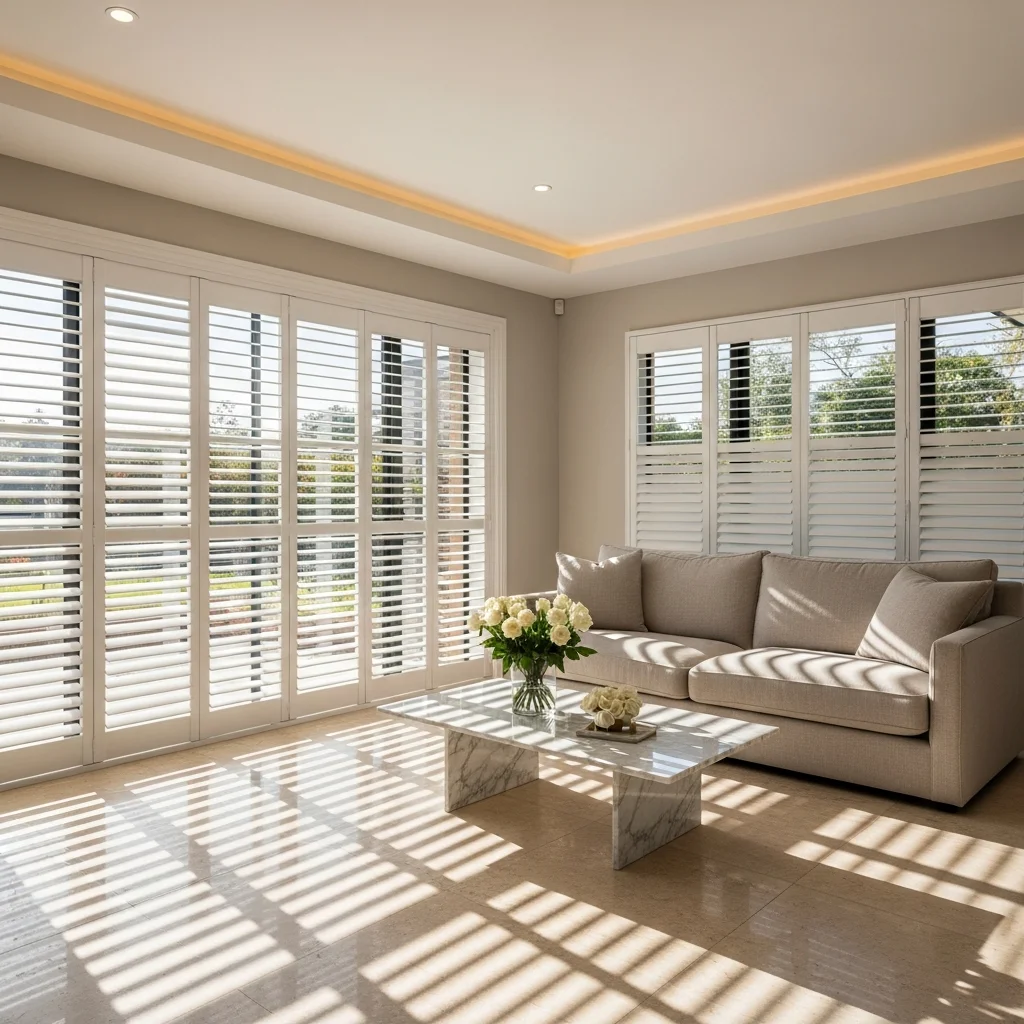
Comparison, coastal-built
Basswood vs Poly Shutters: Which Survives Florida Coastal Life?
From installs across Pensacola, Destin, Panama City Beach, and Mobile: poly for the wet rooms and beachfront primary suites, salt-spec basswood for the interior public spaces, and a mixed package for most homes.
The choice, framed for the coast
Two materials, one coastal-specific decision.
Plantation shutter material selection on the Florida Panhandle is a different conversation than the same decision in Atlanta. The Gulf onshore wind drives salt mist five miles inland on a normal afternoon. Humidity averages above 70 percent from May through September. The UV intensity on west and Gulf-facing elevations is materially higher than what an inland home faces. All three of those variables push the decision toward poly composite in more rooms than you would spec inland.
That said, basswood with salt-spec hardware still works beautifully in the right rooms. We have installed stained basswood across Pensacola's East Hill and North Hill historic districts, Gulf Breeze's Tiger Point, the Fairhope Craftsman cottages, and the Mobile Spring Hill Greek Revivals for 25+ years with no material failure. The trick is knowing which rooms basswood survives in and which rooms demand poly.
This page is the head-to-head, written for the coastal homeowner. It covers cost, durability, finish options, salt-air behavior, and the mixed-spec approach that most of our Panhandle installs end up using. The plantation shutters cornerstone covers the full material catalog. The Florida cost guide covers the pricing math in detail.
Head-to-head, by category
How they compare on the seven variables that matter on the coast.
Cost
Poly wins. On the Panhandle, poly installs at $25 to $35 per square foot; salt-spec basswood at $35 to $45 painted, $40 to $50 stained. Add the $5 to $10 coastal upcharge for beachfront. Poly saves roughly 25 to 35 percent on the same opening.
Moisture and salt-air resistance
Poly wins decisively. Poly is impervious to humidity and salt mist; the surface does not react. Salt-spec basswood survives interior conditioned environments cleanly but should not be installed in rooms with daily steam, beachfront primary baths, or unconditioned screened porches.
Finish options
Basswood wins decisively. Stained basswood is the only material that delivers a coastal-driftwood, weathered-oak, or natural-wood-grain look. Poly is limited to baked-on white, off-white, and a small palette of pre-mixed neutrals. For the architecturally appropriate look on a North Hill Acadian or a Fairhope Craftsman, basswood is often the only practical option.
UV behavior
Quality poly wins slightly. The baked-on finish on Hunter Douglas Palm Beach Polysatin holds color and gloss against Gulf-facing UV for 20+ years. Stained basswood with quality UV-inhibitor topcoats holds 15 to 20 years before noticeable fade. White painted basswood and white poly are visually indistinguishable in UV durability.
Panel weight and maximum width
Basswood wins. Poly tops out at 32 to 36 inches wide before the louvers sag; basswood handles up to 42 inches. For the wide Gulf-facing picture windows common in Destin Holiday Isle and Carillon Beach builds, basswood is often the only material the hardware will support.
Lifespan
Poly wins in beachfront conditions; tie in interior conditioned environments. Poly lasts 25 to 30 years in any Florida environment. Salt-spec basswood lasts 25 to 30 years in interior conditioned spaces, 12 to 18 years in beachfront primary baths or unconditioned spaces. Match material to environment.
Hardware corrosion
Both require marine-grade hardware on the coast. For Panhandle installs we standardize on stainless hinges and sealed louver pins regardless of material. The hardware upgrade is the same cost on both basswood and poly; it is the material itself that drives the per-square-foot difference.
When to pick basswood on the coast
Basswood is the right call when…
You want a stained-wood look
Coastal driftwood gray, weathered oak, whitewash, or natural cherry tones all require stained basswood. Norman Woodlore stocks several coastal-tone factory stains. The Fairhope bay overlooks and the Pensacola North Hill restorations almost always spec stained basswood for the interior public rooms.
The opening is wider than 36 inches
Gulf-facing picture windows in Destin Crystal Beach beachfront homes and the Carillon Beach great rooms routinely run 48 to 84 inches wide. Past 36 inches, poly louvers sag. Basswood is the practical material for these openings even when the room is otherwise high-humidity.
The home is second-row or inland
Bluewater Bay (Niceville), Pace, Pensacola East Hill (3+ miles inland), Daphne, Spanish Fort, Mobile Spring Hill, and Foley are inland enough that salt mist is minimal. Salt-spec basswood with marine hardware works for the whole house, not just the public rooms.
The room is interior and conditioned
Living rooms, dining rooms, formal entries, libraries, offices, and second-floor bedrooms in any Panhandle home. These are the rooms where moisture is normal interior and the architectural statement matters. Basswood is the default for roughly 50 percent of what we install on the Panhandle.
When to pick poly composite
Poly is the right call when…
The room takes regular moisture or salt mist
Bathrooms with daily showers, kitchens, laundry rooms, beachfront primary bedrooms, screened porches, condo openings facing the Gulf. These are the rooms where poly survives decades and basswood will fail. Hunter Douglas Palm Beach Polysatin is the canonical product for this use case.
The home is beachfront or within one mile of the Gulf
Holiday Isle, Crystal Beach, Pensacola Beach, Navarre Beach, Carillon Beach, Panama City Beach gulf-front. The salt mist is constant. Poly is the safer default in most rooms; basswood remains the right call for wide interior openings and stained-wood architectural moments.
You want the lowest-cost shutter that still feels premium
Poly is materially cheaper than basswood but does not feel cheap. The Hunter Douglas Palm Beach Polysatin and Norman Woodlux poly composite lines carry the same lifetime warranty as their wood counterparts. For full-house coverage on a budget, poly is the practical answer.
You only want white or off-white
If the finish goal is "clean coastal white," there is no perceptible visual difference between white painted basswood and white poly. Save the money and put it toward more rooms or motorization. White poly is the most-installed Panhandle product for a reason.
The cost comparison
What the price difference looks like on the Panhandle.
Across a typical Panhandle plantation shutter install, poly composite saves 25 to 35 percent over salt-spec basswood. On a 20-window whole-house package, that is $4,500 to $8,000 in savings if you spec poly throughout, or $2,500 to $4,500 if you do the typical mixed spec (poly in wet rooms, basswood in interior public rooms).
For a Destin Crystal Beach primary bath with a 36 by 48 inch window: poly installs at roughly $360 to $420 per opening with coastal upcharge, basswood painted at $480 to $580. For a Pensacola East Hill living room bay with a 60 by 72 inch window: poly does not work at this width, salt-spec basswood painted installs at $940 to $1,160, stained basswood at $1,150 to $1,400.
The mixed-spec approach is the most common pattern we install on the Panhandle. A typical Gulf Breeze home with 18 windows might land $11,200 painted basswood throughout, $8,800 all poly, or $9,800 with the standard mix. The mixed spec balances cost with the right material in each room.
Final price comes from in-home measure. No obligation. 50% deposit, balance install day.
Real Panhandle room-by-room calls
How the decision actually goes on the coast.
Destin Holiday Isle beachfront primary bath
A 36 by 48 inch window directly above a soaker tub, 200 feet from the Gulf. Daily salt mist through the cracked-open slider, year-round humidity above 75 percent during use. Hunter Douglas Palm Beach Polysatin in white, 2.5 inch louvers, hidden tilt rod, marine hinges. Installed at $410. Basswood would warp inside 4 years; poly will look identical at year 20.
Pensacola North Hill historic living room
1908 Acadian-Creole cottage, three blocks inland from the bay. Three bay windows under a heart-pine picture frame, each 30 by 60 inches. Stained salt-spec basswood in a coastal weathered oak match, 3.5 inch louvers, decorative L-frame, divider rails. Installed at $2,650 for the three openings. Salt mist is minimal at this distance and the architectural language demands real wood.
Pace new-build great room and primary suite
Mixed package: poly composite in the primary bath and kitchen (4 openings), painted salt-spec basswood across the great room, dining, and bedrooms (12 openings). All Norman product, marine hinges throughout, 2.5 inch louvers consistent across the home. Installed total: $10,400. Per-window average: $650. Lead time: 5 weeks.
The blinds and shades that you recommended were a perfect gift. When our daughter returned from her honeymoon, she had trouble believing that we got everything for the price we paid.Susan Farrish, Panama City, FL
Where we install both materials
Across the Panhandle and South Alabama.
Coastal questions homeowners ask
The decision, in plain terms.
Should Florida coastal homes always use poly shutters?
Not always, but poly is the default in moisture-heavy rooms (bathrooms, kitchens, laundry rooms, beachfront primary bedrooms). For interior public rooms in second-row and inland builds (Pace, Daphne, Bluewater Bay), salt-spec basswood still works well and provides finish options poly cannot match. Most Panhandle homes end up with a mixed spec: poly in the wet rooms, basswood in everything else.
Does salt air damage basswood plantation shutters?
Salt air does not directly damage properly finished basswood. What it can damage is unsealed end-grain and hardware (hinges, tilt rods) on cheap basswood lines. For Panhandle installs we spec marine-grade hardware and sealed end-grain finishes on basswood from Norman or Hunter Douglas. Properly spec'd basswood survives Pensacola and Destin interiors for 25+ years; the issue is hardware quality, not the wood itself.
How much more does basswood cost than poly in Florida?
On the Panhandle, basswood with salt-spec hardware runs $35 to $45 per square foot painted, $40 to $50 stained. Poly composite runs $25 to $35 per square foot. The basswood premium is 25 to 40 percent, slightly higher than the Georgia premium because of the marine-grade hardware upgrade. For beachfront builds within one mile of the Gulf, add the standard $5 to $10 per square foot coastal upcharge to both materials.
Can poly shutters be stained to look like beach driftwood?
No. Poly composite ships in white, off-white, and a small palette of pre-mixed neutrals only. There is no grain to stain. If you want a coastal-style stained wood look (driftwood gray, weathered oak, white-washed), basswood with the appropriate stain is the only practical option. Norman Woodlore stocks several coastal-tone factory stains.
Which holds up better against humidity in Gulf-facing condos?
Poly composite is the clear winner for Gulf-facing condos and beachfront primary bedrooms with sliding-door humidity. The salt mist plus AC condensation cycle is hard on wood; poly is unaffected. Hunter Douglas Palm Beach Polysatin is the default spec for our Crystal Beach, Holiday Isle, Pensacola Beach, and Carillon Beach condo installs.
Does poly fade in the Gulf-facing UV?
Quality poly composite carries a baked-on finish with UV inhibitors that resists fade for 20+ years. The Hunter Douglas Palm Beach Polysatin line carries a lifetime warranty against fade and yellowing. Cheap poly knockoffs without UV inhibitors will yellow within 5 years in direct Gulf-facing exposure; spec the major-brand product, not a discount line.
Begin here
Let us help you spec the right material for each coastal room.
Tell us where you live on the Panhandle and roughly how many windows you have in mind. We will walk through each room on the consult and recommend basswood, poly, or a mix based on the actual coastal exposure.
No obligation. 50% deposit, balance install day. Marine-grade hardware standard on coastal installs.