
Salt Air Eats Window Treatments Alive, Unless You Choose the Right Ones
You replaced your blinds two years ago and the slats are already warping, the hardware is pitting, and the cords snap every time you try to raise them. If your home sits anywhere between Pensacola Beach and Panama City Beach, that is not bad luck, that is salt air doing what salt air does. The Emerald Coast is one of the most corrosive environments in the country for building materials, and window treatments take the hit daily.
Installing custom window treatments from Gulf Breeze to Orange Beach, we have seen every material fail in ways the product specs never mention. This post lays out exactly what survives salt air, humidity, and Gulf-front sun, and what you should never put on a coastal window.
The right window treatment for an Emerald Coast home is not the prettiest option in the showroom, it is the one built from materials that ignore salt, humidity, and 200-plus days of Gulf sun without warping, pitting, or fading out in two seasons.
Why the Emerald Coast Is So Hard on Window Treatments
Salt air is not just a smell. It carries microscopic chloride particles that land on every surface in your home, window frames, louver hardware, roller brackets, cord locks. Metal corrodes. Wood swells. Fabric fades and mildews. The closer you are to the water, the faster all of this happens.
Navarre Beach, Okaloosa Island, and the high-rises along Destin's Holiday Isle are the most aggressive zones we work in. A set of standard aluminum mini-blinds on a Gulf-front condo can show visible corrosion inside 18 months. We have pulled out wood shutters from Perdido Key beach houses that looked like driftwood after three years because they were never treated for marine exposure.
Add in the afternoon heat load from a west-facing condo window and you compound the problem. UV degradation, thermal cycling, and salt spray together are a wrecking crew. Your window treatments need to be selected for this specific environment, not just picked off a national big-box shelf.
Materials That Actually Hold Up Near the Gulf
Composite and PVC Plantation Shutters
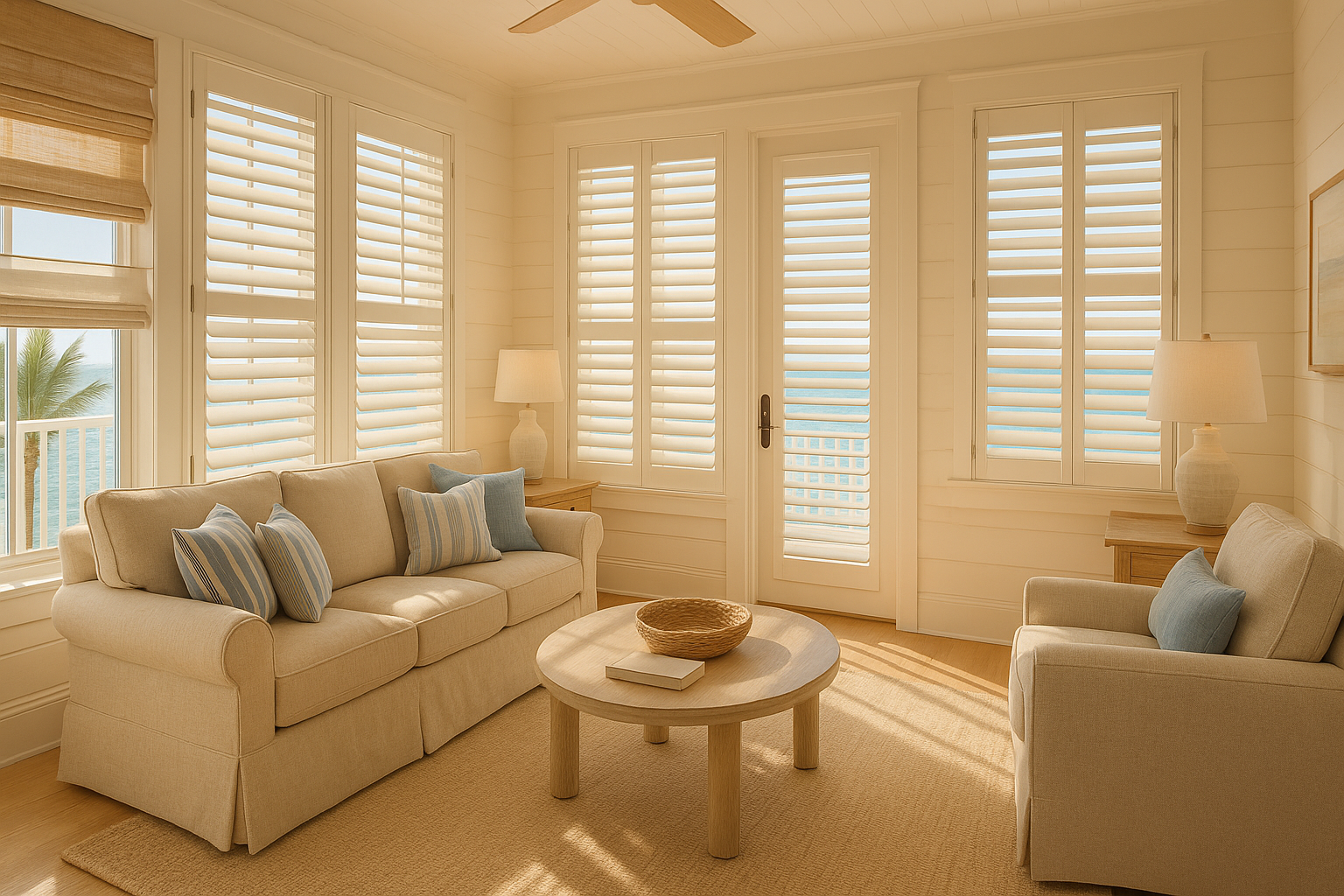
This is our number-one recommendation for any home within a mile of the water, and honestly for most of the Panhandle. Composite shutters, built from a rigid PVC or poly-resin core, will not warp, crack, or yellow in salt air. They do not absorb moisture. The hardware is stainless or coated to resist corrosion. We have installed composite shutters on Gulf-front homes in Destin and Fort Walton Beach that still look installation-day fresh after eight years.
Real wood shutters are beautiful. We love them in homes set back from the water. But on a first-row beach property, wood is a bad investment. It moves with humidity, and Gulf Coast humidity is relentless from May through October. Composite takes all of that and does not budge.
If you are in Pensacola or along the beaches in Santa Rosa County, our plantation shutters in Pensacola page walks through the specific options we recommend for each exposure level. For Gulf County and Bay County customers, our team covers plantation shutters in Panama City Beach with the same approach.
Aluminum and Faux-Wood Blinds, With the Right Hardware
Not all blinds fail in salt air. The problem is usually the hardware, not the slat itself. Standard zinc die-cast brackets and steel components rust fast. We specify blinds with UV-stabilized polymer components and stainless or coated hardware for coastal installations.
Faux-wood blinds in a composite material are a smart choice for interior rooms. They handle humidity swings without bowing, and they are easy to wipe down when salt film builds up on the glass. For custom blinds in Gulf Breeze homes, faux-wood in a warm white or driftwood finish is one of our most popular selections right now.
Solar and Roller Shades in Marine-Grade Fabrics
A quality solar shade does double duty on the Emerald Coast: it blocks UV and reduces glare without blacking out the water view you paid for. The key word is quality. Cheap roller shade fabrics turn brittle and discolor in 18 months under Gulf sun. We use fabrics rated for coastal environments, high-UV-resistance weaves from brands like Phifer Suntex and Mermet E-Screen, that hold their color and structural integrity for years.
Roller shades are also a natural fit for motorization, which matters on tall windows and in vacation rentals where guests need simple operation. Our motorized shades in Destin installations lean heavily on solar fabrics for Gulf-front condos, and the feedback from both owners and rental guests is consistently strong.
Woven Wood and Natural Shades, Know Their Limits
Woven wood shades look stunning in a coastal cottage. Seagrass, jute, and bamboo weaves bring in texture that feels right for a beach house. But these materials are organic, and organic means vulnerable to moisture and mildew in high-humidity rooms. We install them regularly in living rooms and bedrooms where the AC runs consistently, but we steer clients away from using them in bathrooms, kitchens, or unconditioned sunrooms near the water. Matched to the right room, they perform well and age gracefully.
What to Avoid on a Coastal Window
- Standard wood blinds, They bow, warp, and grow mildew on the back slat surface within a single humid season.
- Untreated real wood shutters, Beautiful inland, but a salt-air casualty on anything within sight of the Gulf without aggressive sealing and maintenance.
- Cheap aluminum mini-blinds with standard zinc hardware, The slats may survive, but the tilt rod, cord lock, and brackets will corrode and fail.
- Low-grade vinyl roller shades, UV causes cracking and yellowing fast. The fabric stiffens and the hem bar warps with thermal cycling.
- Fabric Roman shades in non-treated material, Moisture wicks into the folds and mildew sets in quickly in a beachfront setting without consistent climate control.
We are not anti-fabric or anti-wood across the board. Context is everything. The same Roman shade that thrives in a Pace subdivision might be a mess in a Gulf Shores condo three months into summer.
Practical Tips for Extending the Life of Any Coastal Window Treatment
Even the right material needs a little help in a marine environment. Here is what we tell every customer on the Emerald Coast after installation:
- Wipe down hardware monthly. A damp cloth on brackets, tilt rods, and cord locks removes chloride buildup before it starts to pit the surface.
- Keep the AC running consistently. Humidity spikes when the air handler shuts off for weeks during an unoccupied season. That is when mold and warping happen fastest.
- Close shutters or lower shades during storms. Even an afternoon thunderstorm can drive salt-heavy moisture through a cracked window and soak fabric treatments nearby.
- Check louver staples and tension annually. Composite shutters are durable but the tension on the louver bar can loosen over time, especially in temperature-swinging sunrooms. A quick adjustment keeps them operating perfectly.
- Choose motorization for high or hard-to-reach windows. Manual operation on a 10-foot palladium window above the Gulf means reaching, straining, and, eventually, yanking. A motorized system removes the mechanical stress on the shade itself.
We Have Done This Since 1996, Let Us Make It Simple for You
Every neighborhood on the Emerald Coast has its own exposure conditions. A canal-front home in Niceville behaves differently than a Gulf-front unit on Okaloosa Island. A screened porch in Navarre faces different challenges than a tinted-glass high-rise in Destin. We do not sell you one answer for every situation, we come to your home, look at your windows, and tell you exactly what will hold up and what will not.
Our in-home consultations are free and we typically respond to inquiries within an hour. We bring samples, measure your windows, and walk you through the options that make sense for your specific exposure, your budget, and your style. No pressure, no guesswork.
Ready to stop replacing treatments every two years? Schedule your free in-home consultation today and let our team build you something that lasts on the Gulf Coast. Call us at 850-889-7772 or email Michael@paylessblindsFl.com, we would love to help.