
The Gulf Coast Privacy Problem Every Beach Homeowner Knows
You paid for that view of the Gulf, the turquoise water, the white sand, the sunset that turns the sky orange over Navarre Beach. The last thing you want is a window treatment that blocks it. But by 9 a.m. on a summer morning, strangers on the boardwalk can see straight into your living room, and the glare off the water is already giving you a headache.
This is the defining tension of beach house living on the Emerald Coast. Privacy and views feel like opposites, but they are not. The right materials, at the right opacity, installed correctly, give you both. We have been solving exactly this problem for homeowners from Perdido Key to Panama City Beach since 1996, and there are specific products that work and specific ones that fail in a salt-air environment.
The right window treatment for a Gulf-front home does not force you to choose between your privacy and your view, it gives you precise control over both, even in a salt-air environment.
Why Standard Window Treatments Fail on the Coast
Before we talk solutions, understand why so many beach homeowners end up replacing their window treatments within three or four years. Salt air is relentless. It works into aluminum headrails, corrodes lift mechanisms, and degrades fabric weaves faster than anything you will encounter inland. A set of faux-wood blinds that would last fifteen years in a Pace subdivision might look warped and discolored after two hurricane seasons in a Gulf Breeze condo.
Humidity compounds the problem. Even on calm days, a Gulf-front home cycles through wide swings in moisture. Wood that is not properly treated or engineered will warp, swell, and bind. Fabrics that are not solution-dyed will fade from UV exposure in a single summer facing west toward the water.
Then there is the functional gap. Most off-the-shelf shades sold at big-box stores come in two modes: open or closed. That binary does not work when you want to watch the dolphins in the afternoon and also want guests on the deck to stop peering into your bedroom. You need something with a real range.
The Best Materials for Gulf-Front Privacy and View Preservation
Solar and Roller Shades: The Workhorse of Beach House Privacy
For large picture windows and floor-to-ceiling glass, a quality solar roller shade is the most effective solution we install. The key metric is openness factor, expressed as a percentage. A 3% openness fabric blocks roughly 97% of incoming light and gives you strong privacy from outside while still allowing you a clear, filtered view of the water. A 10% openness fabric lets in more light and feels more transparent from inside, but still prevents clear sightlines from the outside during daylight hours.
We carry solar fabrics in solution-dyed polyester and fiberglass-reinforced weaves that resist UV degradation and do not absorb moisture. These are not the flimsy pull-down shades you used in a college apartment. The hardware we install is marine-grade aluminum or UV-stabilized polymer, nothing that will pit or seize up after one summer of salt exposure.
For west-facing condos in Destin or along Scenic Highway 98, we often recommend a 3% or 5% openness in a mid-tone color. You keep the view during the day, block the brutal afternoon sun, and have genuine privacy when the beach crowd is at its thickest. Learn more about our roller shades and how we size them for large coastal windows.
Plantation Shutters: The Classic That Earns Its Price on the Coast
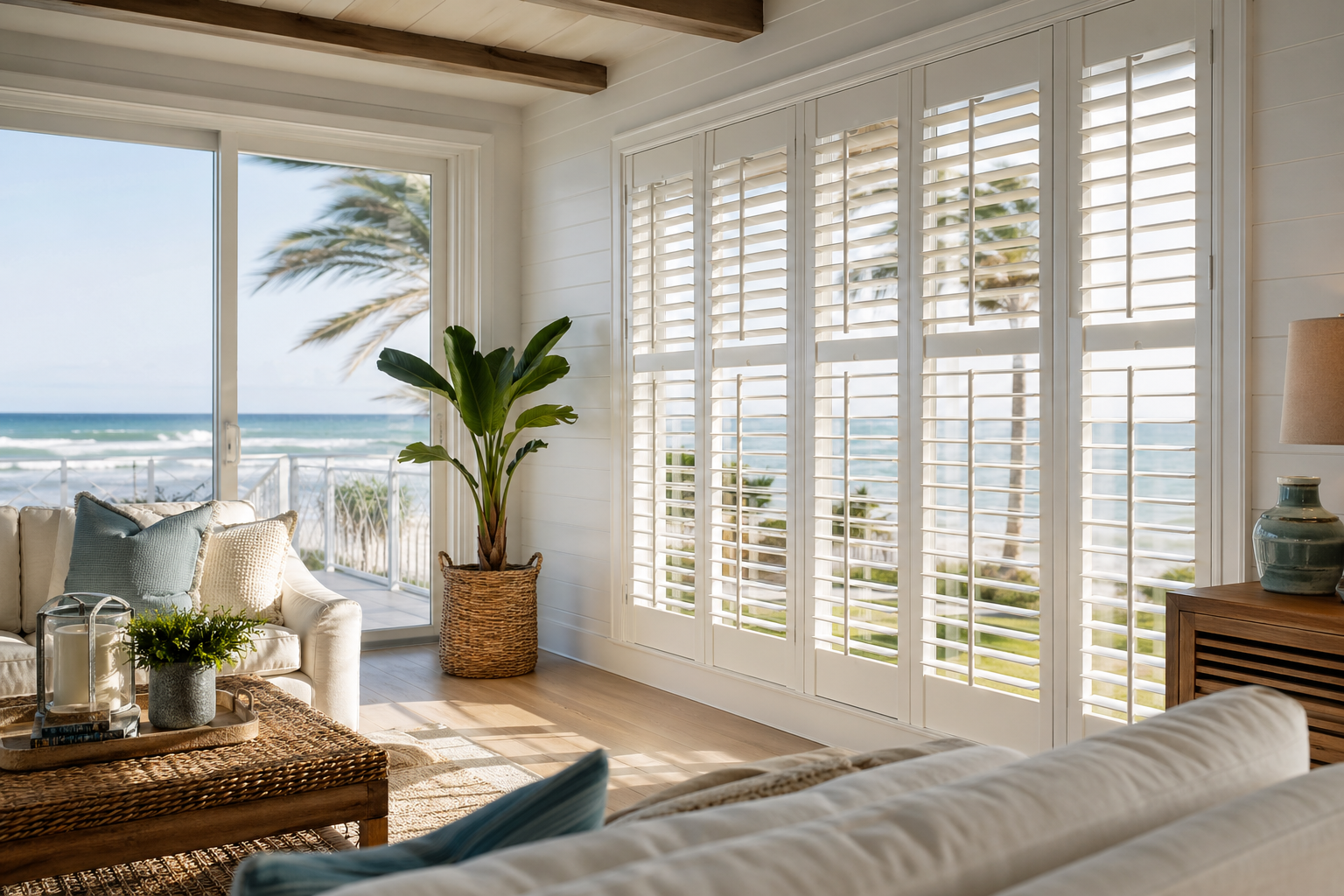
No product we install generates more repeat referrals in Gulf Coast neighborhoods than a properly specified plantation shutter. The reason is simple: louver control. Tilt the louvers up, and you redirect light toward the ceiling while maintaining a view of the waterline. Tilt them down, and you see the sky and the upper Gulf while blocking sightlines from anyone at deck or street level. Close them completely before a storm and you have an additional layer of protection for your glass.
For beach houses, we almost always specify a composite or PVC-core shutter rather than a real-wood shutter. The PVC core does not absorb moisture, does not warp in humidity swings, and is completely immune to the salt-air corrosion that will eventually ruin an untreated wood shutter. These shutters carry a lifetime warranty, which matters when your home is one mile from the water.
If you are in the Pensacola area and considering shutters for a Gulf-front or bay-front property, our Pensacola plantation shutters page covers the specific options and sizing considerations for that market. For homes along the 30A corridor or Destin Harbor, the same principles apply, we measure and fabricate to your exact window dimensions.
Woven Wood Shades: Texture and Natural Light Without Full Transparency
Not every beach house window faces the water. Many homeowners want something warmer and more organic for interior rooms, reading nooks, or north-facing windows where glare is not the primary issue. Woven wood shades, made from sea grass, jute, bamboo, or rattan, add a natural texture that fits Gulf Coast interiors without feeling like a resort hotel catalog.
These shades filter light beautifully and provide daytime privacy from most angles, though they are not a blackout solution. For a bedroom in a Rosemary Beach cottage or a breakfast nook in a Santa Rosa Island rental, they hit the right balance of light, warmth, and coastal aesthetic. Our woven wood shades are available with fabric privacy liners if you need more complete light block without changing the look of the shade from the street.
Motorization: The Feature Every Beach Rental Owner Needs
If you own a vacation rental in Panama City Beach, Destin, or Orange Beach, motorized window treatments are not a luxury. They are a practical necessity. Guests do not read instruction cards. They yank cords, force tilt rods, and leave shades partially raised in positions that stress the lift mechanism. After a few rental seasons, manually operated shades in high-traffic properties show the damage.
Motorized roller shades and motorized plantation shutters eliminate the cord entirely. There is nothing to yank. Operation is app-controlled or by a simple wall switch that even first-time guests figure out in thirty seconds. You can set automation schedules, shades down during peak afternoon sun, open at sunset, that protect your furnishings and reduce cooling costs without any guest involvement.
We install Somfy and Lutron motorization systems that are compatible with most smart home platforms. For property managers handling multiple units in the same building, the ability to control all window treatments from one app is a genuine operational advantage. Our Destin motorized shades page has more detail on the systems we recommend for both owner-occupied and rental properties.
How to Layer Treatments for Full Range Control
The homes we install that generate the most satisfaction from their owners almost always use a layered approach. Here is what that looks like in practice for a Gulf-front living room:
- Solar roller shade on a double bracket: A 3% openness shade for daytime privacy and glare control, a blackout roller behind it for sleeping in or storm darkness.
- Plantation shutters on the side lights: Full louver control for directing light and blocking sightlines from the angle of the walkway or neighboring unit.
- Motorized lift on both shades: One remote or app controls both layers independently. No cords crossing, no fumbling with separate mechanisms.
This layered setup costs more than a single product, but it performs across every condition, bright Gulf sun at noon, privacy during a crowded beach weekend, blackout during a storm, and a clear open view at sunrise when the beach is empty. That range of performance is why we recommend it for primary residences and higher-end rental properties alike.
We do not upsell layering where it is not warranted. A north-facing bedroom in a Navarre ranch house does not need a double-roller setup. But for the living room wall of glass that faces the water, that is where the investment pays back every single day.
Talk to Someone Who Has Installed on the Gulf Coast
Every beach house window is different. The orientation, the distance from the water, the HOA rules, the rental platform requirements, the existing interior style, all of it shapes what we recommend. That is why we do free in-home consultations. We come to your home, measure every window, assess the light and sightline conditions, and give you a specific recommendation with a written quote before we leave.
We serve homeowners and property managers across the Florida Panhandle and Emerald Coast, including Pensacola, Gulf Breeze, Navarre, Fort Walton Beach, Destin, and Panama City Beach, as well as Mobile, Gulf Shores, and Orange Beach in South Alabama. Call us at 850-889-7772 or schedule your free consultation online. We respond within one hour.