
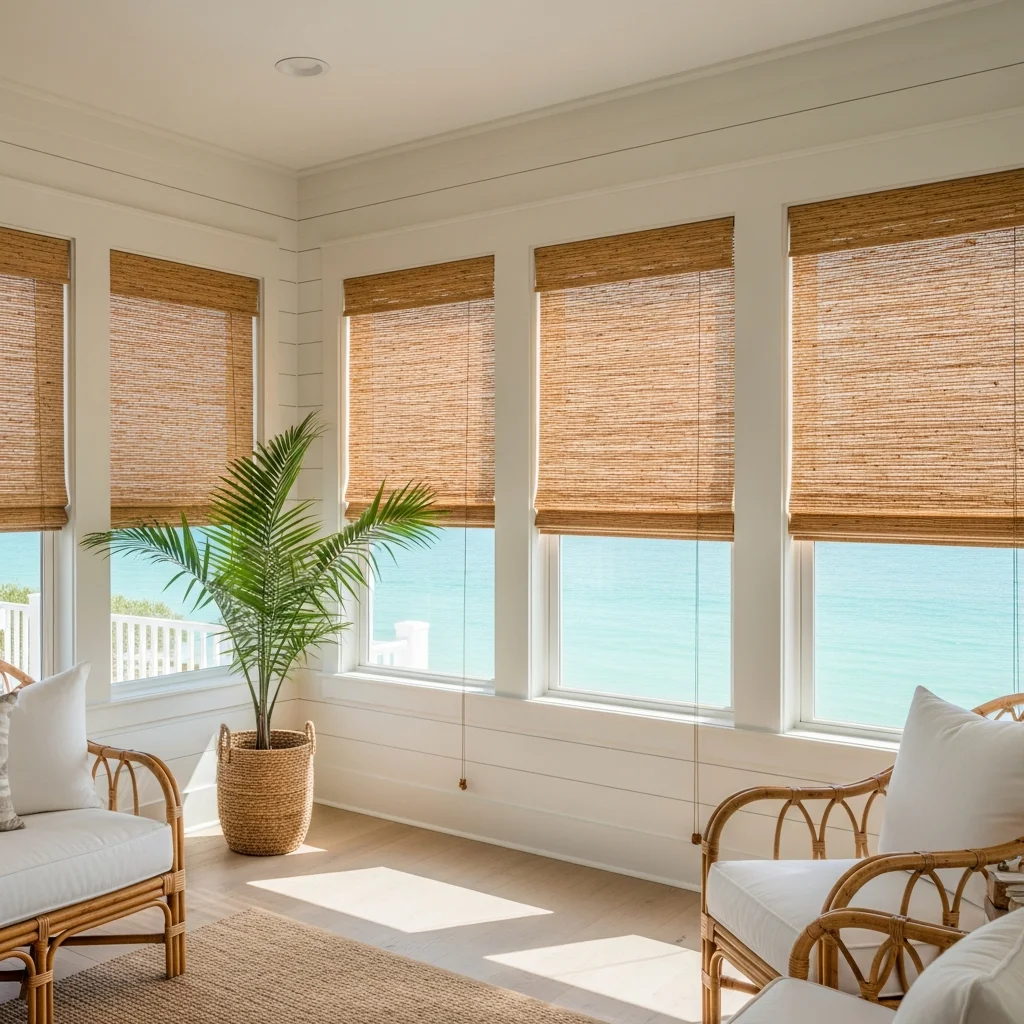
Real Wood Does Not Stand a Chance Against Pensacola Air
If you have ever pulled a cord on a real wood blind after two Gulf Coast summers and watched a warped slat refuse to tilt, you already know the problem. Pensacola sits at the intersection of high humidity, salt-laden sea breezes off Pensacola Bay, and summer temperatures that push heat indexes past 105 degrees, and real wood simply cannot take that combination year after year.
Our thesis is straightforward: for the vast majority of Pensacola and Gulf Coast homes, faux wood blinds are the smarter, longer-lasting, and ultimately more cost-effective choice over real wood. We have been installing window treatments across the Panhandle since 1996, and we have watched this play out in home after home from East Hill to Gulf Breeze Proper.
"On the Gulf Coast, the enemy of real wood blinds is not time, it is moisture. Faux wood wins that fight every single time."
What Gulf Coast Humidity Actually Does to Real Wood Slats
Wood is hygroscopic. That is a technical way of saying it absorbs and releases moisture from the surrounding air. In a climate like Pensacola's, where average relative humidity runs between 70 and 90 percent for much of the year, that cycle never stops.
During the summer, moisture swells wood fibers. During our brief dry spells in winter, those fibers shrink back. Repeat that expansion and contraction across 50 or 60 slats in a single blind, and you get bowing, cupping, and slats that no longer lie flat. The tilt mechanism starts binding. The ladder cord pulls unevenly. Within two to three years, a real wood blind that looked beautiful in the showroom starts looking like it belongs in a storm-damaged camp house on Perdido Key.
Salt air accelerates the problem. The fine aerosol that drifts off Escambia Bay and the Gulf does not just corrode metal hardware, it penetrates wood grain, disrupts the finish, and promotes mold growth in the microscopic gaps between the finish coat and the raw fiber underneath. We have pulled real wood blinds out of Gulf-front condos in Perdido Key that were less than 18 months old with visible black spotting on the slats.
The finish itself becomes a liability. Factory lacquers and paints on real wood blinds are not designed for daily exposure to salt mist. They yellow, chalk, and peel. Once the finish breaks, moisture invasion accelerates, and the slat degrades from the inside out.
How Faux Wood Blinds Are Engineered Differently
Quality faux wood blinds are made from a composite of PVC or a PVC-and-wood-fiber blend. The best products use a solid PVC core with no wood content at all. That material simply does not absorb moisture the way natural wood does. It will not warp, bow, cup, or swell regardless of what the hygrometer reads in your laundry room or your Gulf-front master bath.
Here is what that means in practical terms:
- No warping. Slats stay flat and tilt evenly year after year, even in high-humidity rooms like bathrooms, laundry rooms, and kitchens.
- No fading from UV. Quality faux wood slats are UV-stabilized during manufacturing, not just coated on the surface. The color goes deeper than a thin paint layer.
- No mold or mildew growth. PVC does not give mold the organic food source it needs to colonize. A damp cloth cleans them completely.
- Salt-air resistance. The finish on a solid PVC slat holds up against the aerosol environment you get within a half mile of the water, and beyond.
- Weight advantage. Faux wood slats in a 2-inch width weigh about the same as real wood, but the hardware and lift systems are designed for consistent, predictable load. Warped slats change that load unpredictably and wear out cordless and motorized lift mechanisms faster.
We stock and install composite faux wood blinds for Gulf Breeze homeowners who are tired of replacing real wood every two or three years. The conversation almost always ends the same way: "Why did no one tell me this ten years ago?"
Where Faux Wood Blinds Make the Most Sense on the Gulf Coast
Not every room or application is the same. Here is where faux wood pulls ahead the most decisively in a Pensacola or Navarre home.
Bathrooms and Laundry Rooms
These are the highest-humidity rooms in any home. Steam from showers, moisture from towels drying, and the heat cycling from dryer exhaust create a micro-environment that will destroy real wood in under a year. Faux wood blinds handle it without a second thought. We install them in master baths in beachfront homes from Pensacola Beach to Panama City Beach because nothing else makes practical sense in those spaces.
West-Facing Windows
West-facing windows on the Gulf Coast take a brutal combination of afternoon heat and direct UV exposure for four to six hours every single day. The surface temperature of a closed slat on a west window in July can exceed 140 degrees Fahrenheit. Real wood under that kind of direct solar load will bleach and check, develop small surface cracks, within one to two seasons. Faux wood holds its finish and structural integrity under the same conditions.
Vacation Rentals and Beach Houses
If you manage a rental property on Pensacola Beach or Navarre Beach, faux wood is a no-brainer. Rental guests are not gentle with window treatments. They yank cords, forget to close blinds before storms, and let the salt air circulate through open windows for weeks at a stretch. Faux wood tolerates all of that. It also wipes down fast between guests, a huge advantage when a cleaning crew has a two-hour turnaround on a Saturday.
Whole-House Installs on a Budget
Real wood blinds cost more per blind, and they cost more again when you replace them every few years. A full-house faux wood install typically runs 20 to 40 percent less upfront than the equivalent in real wood, and the replacement cycle stretches from two to three years to ten or fifteen, or longer if you choose a high-quality composite. That arithmetic is hard to argue with. Our custom blinds page gives you a look at what we carry and the materials we recommend for different applications.
When Real Wood Still Makes Sense
We are not saying real wood has no place on the Gulf Coast. In a climate-controlled interior room with no direct moisture exposure, a formal dining room, a study, a bedroom that never faces the Gulf, real wood can perform well and delivers a warmth and grain depth that PVC cannot fully replicate.
If your home in East Pensacola Heights or Cordova Park has original wood floors and trim, and you want the window treatment to carry that same material story, real wood blinds in a stain-matched finish can make architectural sense. The key word is interior. Keep real wood away from moisture, salt air, and heavy UV, and it will last.
For everything else, especially anything within a mile of the water, faux wood is the right call.
What to Look for When You Buy Faux Wood Blinds
Not all faux wood is equal. A thin slat with a hollow core will not perform as well as a solid PVC composite, and the hardware matters just as much as the slat material. Look for these specifics when you are comparing products:
- Solid PVC or composite core. Avoid hollow slats if you are installing in a high-humidity room. Hollow cores can trap moisture internally if the end caps are not perfectly sealed.
- 2-inch slat width. The 2-inch slat is the most structurally stable size for faux wood. Wider slats, 2.5 inch, can flex under their own weight over time in cheap composites.
- UV-stabilized color. Ask whether the color is surface-applied or integral to the material. Integral color will not chalk or peel.
- Moisture-resistant hardware. The ladder cord, lift cord, and head rail components should be rated for humid environments. Cheap metal components corrode in salt air almost as fast as the wood slats they replaced.
- Manufacturer warranty. We carry products backed by strong manufacturer warranties, and we stand behind our installations with our own service commitment.
Our team measures every window precisely before ordering. Custom-fit slats minimize the gap between the blind and the frame, which reduces the amount of salt air that circulates directly over the slat surface, a small detail that adds years to the product's life in a coastal environment.
Talk to Someone Who Knows the Gulf Coast
We have been doing this since 1996. We have installed blinds in concrete-block cottages on Pensacola Beach that have come through four major hurricanes and are still functioning perfectly today. We have also pulled out real wood blinds from gorgeous homes in Bayou Texar that looked like driftwood after two wet seasons. The difference almost always came down to material choice.
If you are ready to stop replacing blinds every few years and want a recommendation built on Gulf Coast installs, we would like to come see your windows. Schedule your free in-home consultation and we will measure every window, walk you through material options, and give you a straight answer on what will hold up in your specific home and neighborhood. Call us at 850-889-7772 or email Michael@paylessblindsFl.com. We respond within one hour.